A Simple System for Clutter That Actually Sticks
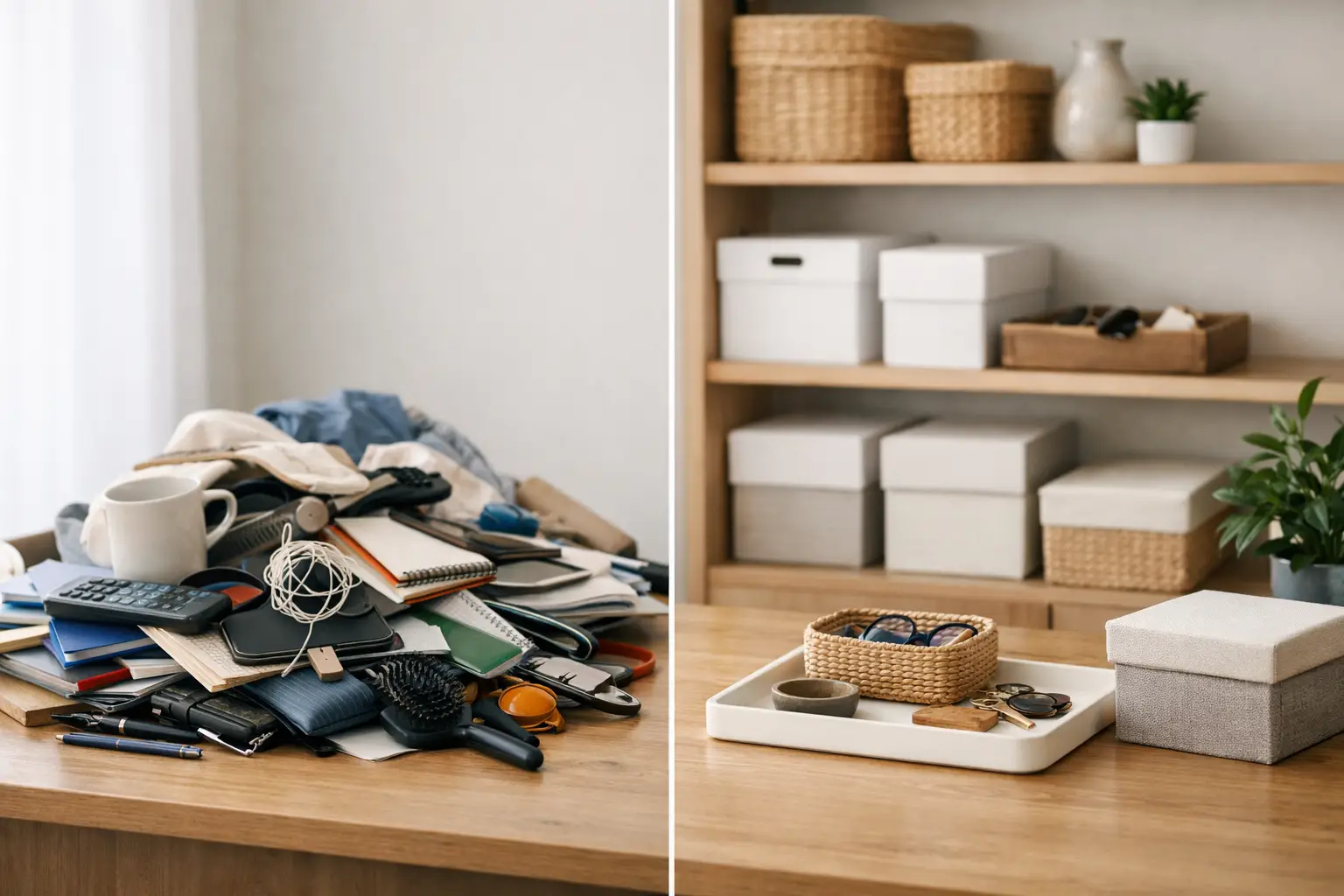
The kitchen counter is not the problem. Neither is the chair holding clean laundry, the drawer that jams, or the bag of items you meant to donate last month. The problem is that most people do not have a simple system for clutter. They have bursts of effort followed by no clear rule for what happens next.
You do not need a shopping trip, matching containers, or an entire free weekend. You need a repeatable way to make decisions in a small area, give useful items a home, and prevent the same pile from rebuilding. Start small enough that you can finish. Then use the same system again.
Why clutter returns after a big cleanup
A major cleanup can feel productive because the visible change is immediate. But clearing a room is not the same as creating a system. If incoming mail, shoes, laundry, work materials, and random purchases do not have a defined path, they will settle in the nearest open space.
Clutter is often delayed decision-making. An item stays on the counter because you are not sure whether to keep it. A box stays in the hallway because its destination has not been decided. A surface fills because it has become a temporary home for everything without a real home.
This is not a character flaw. It is a design problem. Your space needs fewer decisions, clearer boundaries, and a reset that works on a tired Tuesday night.
Build a simple system for clutter with one meter
Use one meter as your working limit. One meter is roughly the width of a small desk, a section of countertop, one shelf, or a narrow strip of floor. It is large enough to produce a visible result and small enough to finish without losing focus.
Choose an area that creates daily friction. Do not begin with the attic, garage, or a closet full of old memories unless that space is blocking your life right now. Begin where clutter interrupts your routine: the entry table, the kitchen counter, the bathroom cabinet, or the place where you work.
Set a timer for 20 minutes. Your goal is not to organize your whole home. Your goal is to restore one meter to useful condition.
Step 1: Empty only the area you selected
Remove everything from that one-meter zone. Wipe it down if needed. Starting with an empty surface matters because it makes the actual purpose of the space visible again.
Ask one question before you put anything back: What is this area supposed to help me do? A kitchen counter may be for preparing food. A desk may be for focused work. An entryway may be for arriving home and leaving prepared.
If an item does not support that purpose, it should not automatically return.
Step 2: Make fast decisions, not perfect ones
Handle each item once and place it into a clear outcome. Keep it in this zone, move it to its actual home, donate or discard it, or place it in a short-term decision box.
The decision box is useful for items that require more thought, such as paperwork, sentimental objects, or equipment you may need soon. But it needs a date. Write the date on it and review it within 30 days. A decision box without a deadline becomes a storage box with a nicer name.
Do not create a vague “deal with later” pile. That pile is where momentum goes to disappear.
Step 3: Give kept items a specific home
“Somewhere in the kitchen” is not a home. “The second drawer beside the stove” is a home. A home is specific enough that another person could put the item away without asking you.
Keep the home close to where the item is used. Chargers belong near the place they are charged. Incoming mail needs one tray near the entrance or workspace. Cleaning supplies should be near the rooms they clean, provided they can be stored safely.
Convenience is not laziness. It is what makes a system repeatable. If putting something away takes three extra steps, you will eventually leave it out.
Step 4: Set a capacity limit
Every category needs a boundary. A drawer, shelf, basket, hook, or designated section of a cabinet can become that boundary. When the space is full, do not expand the category automatically. Decide what leaves before something new stays.
This rule is especially useful for paper, clothing, toiletries, hobby supplies, and children’s items. Without a physical limit, these categories grow quietly until they take over more than you intended.
Capacity limits are not about owning as little as possible. They are about keeping what your current space and current life can support.
Use three daily reset points
A clutter system fails when it depends on motivation. Build it into moments that already happen.
The first reset point is when you arrive home. Put keys, bags, shoes, mail, and work items where they belong before you sit down. This can take two minutes and prevents the entryway from becoming a landing zone for the entire household.
The second reset point is after the evening meal. Return the kitchen to its working state. Clear dishes, put away food, and remove anything that does not belong on the counter. A functional kitchen the next morning reduces stress before the day has even started.
The third reset point is before bed. Spend five minutes restoring the one-meter area you are currently maintaining. You are not cleaning the house. You are making tomorrow easier.
If three reset points feel unrealistic, start with one. A system that happens once a day is more useful than an ambitious routine that ends after four days.
Stop clutter at the point of entry
Most clutter enters through predictable routes: mail, shopping bags, school papers, deliveries, hand-me-downs, and digital printouts. The solution is not to process everything perfectly. It is to create a first stop for each stream.
Mail needs one place to land and a quick decision window. Packages need to be opened, recycled, and put away before the box becomes furniture. New purchases should replace or fit beside what you already own. If there is no space for an item, that is useful information. It may not be a good purchase right now.
For families, shared spaces need visible rules. A basket can work for each person’s daily items, but baskets are not the whole system. Each basket needs a reset time and a limit. Otherwise, you have simply moved clutter into containers.
What to do when the clutter is emotional
Some items are harder because they represent money spent, a past version of yourself, a relationship, or a hope you have not let go of. In those cases, speed is not always the right goal.
Use a smaller session. Choose five items, not a full shelf. Take a photo of an object before releasing it if the memory matters more than the object. Keep a defined memory box for truly meaningful items rather than allowing sentimental belongings to spread into every room.
Be honest about the trade-off. Keeping everything may protect you from a difficult feeling for a moment, but it can also keep the space heavy and unusable. You do not have to force a decision today. You do need a boundary around postponing it.
Measure progress by function, not appearance
A space does not need to look like a catalog to work well. It needs to support your real routine. Your desk is successful if you can sit down and begin work. Your closet is successful if you can find clothes that fit your life. Your kitchen is successful if you can prepare food without moving piles first.
This is why a simple system beats a dramatic overhaul. You are building proof that you can regain control in small, repeatable actions. One meter becomes a clean counter. A clean counter becomes an easier morning. Easier mornings create more room for attention, rest, and the work that matters.
Choose one meter today. Finish it before you choose the next one. Then protect that space with a home for every useful item and a short reset you can actually keep.